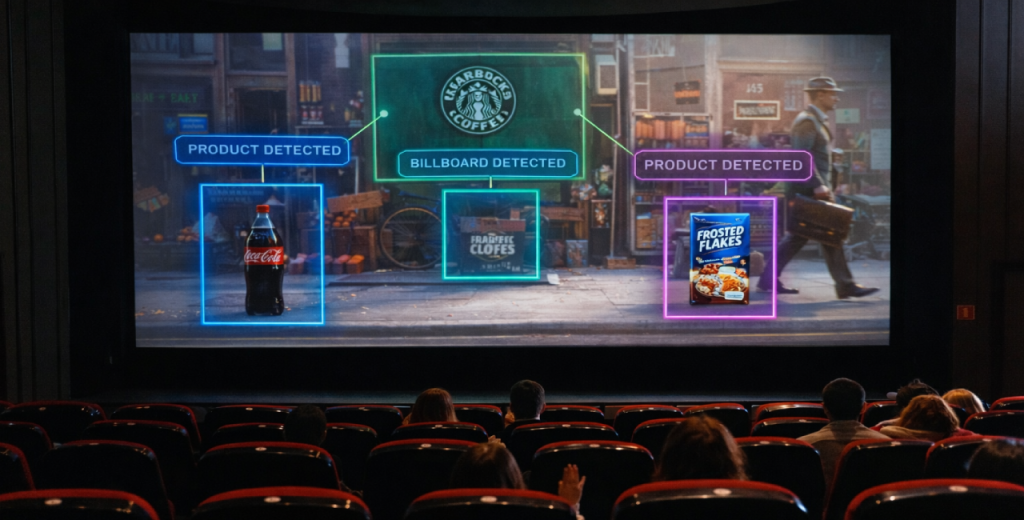
For years, fans of Minority Report have referenced its iconic scenes of personalized billboards calling out to Tom Cruise by name. It felt like pure science fiction. Yet today, we are closer than ever to that reality, not through futuristic holograms but through something far more seamless: AI altering the content inside your movie in real time.
Imagine watching James Bond: Skyfall. In the UK version, Bond’s drink of choice might still be Heineken. But in the Indian theatrical release, that same scene could naturally show a Kingfisher bottle. In Japan, it might be Asahi. Same shot, same moment, different brand for every country, culture and demographic segment. And the audience would never notice the difference.
This is the core promise of AI-powered dynamic advertising. No interruptions. No breaks. No forced pre-rolls. Just a story where the product placements adapt to who is watching.
Why This Matters: A New Frontier for Entertainment and Advertising
China’s Tencent has done early experiments with AI-driven in-scene ad replacement that show how profoundly this approach could reshape the media landscape. Instead of cutting away from the film to show an ad, AI identifies any object in the frame that can be replaced with a targeted brand. The experience becomes both uninterrupted and personalized.
The ripple effects are enormous.
For studios and OTT platforms, this unlocks infinite monetization opportunities. The same content can now have dozens of market-specific integrations, offering revenue models tailored to each region.
For brands, it delivers contextual, high-visibility placements without fighting for scarce inventory or pre-roll attention.
For viewers, it promises a more immersive experience with no pauses and no skipped ads.
And for markets with high diversity across geography, culture, language, consumer behavior, purchase preferences and socio-economic nuances, this level of customization can dramatically increase ad relevance.
The Other Side of the Story: Complexity Behind the Magic
Yet this vision also introduces new creative and technical challenges that the industry must recognize early.
1. Context Awareness Cannot Be an Afterthought
Replacing a coffee cup logo is easy. But replacing it accurately is incredibly hard.
AI must understand the context of the scene, the storyline, the mood and even cultural sensitivities. A cheerful product appearing in a tragic scene, an alcohol brand in a children’s movie, or a mismatched cultural symbol in a historical setting can all damage brand reputation and viewer trust.
Contextual intelligence must become far more sophisticated than simple object detection.
2. Movies Will Need Scene-Level Meta-Tagging on a Massive Scale
For dynamic advertising to work reliably, productions will need:
- Scene-by-scene tagging
- Actor and object metadata
- Emotional tone descriptors
- Story arc markers
- Brand-safe and brand-unsafe zone identification
- Multi-market cultural sensitivity flags
This could fundamentally change how films are produced. Writers, directors, cinematographers and post-production teams may need to collaborate differently. Every frame becomes a potential monetizable asset, which means every frame requires structured data.
It is a major shift in both creative workflow and cost.
3. Ethical and Regulatory Guardrails Will Become Important
When ads can change depending on who is watching, regulators will need clarity on:
- Viewer transparency
- Cultural neutrality
- Audience-profile data usage
- Misleading content boundaries
- Advertising disclosures
This is especially crucial in markets where data privacy is sensitive and laws vary widely.
A Future Full of Possibilities
We are entering an age where entertainment becomes:
- Hyper-personalized
- Revenue-optimized
- Regionally adaptive
- Culturally contextualized
- Seamlessly monetized
For the media and entertainment industry, this is a rare opportunity to reinvent old monetization models without compromising on viewer experience.
Our Point of View at XTS
As AI continues to reshape content creation, distribution and monetization, the most successful players will be those who build systems that combine creativity with deep technical foundations.
Dynamic advertising is only one example of how AI can transform storytelling, and we believe:
- Context-aware AI
- Strong metadata architecture
- Real-time rendering pipelines
- Market-specific personalization engines
- Ethical guardrails
- Multi-region deployment capabilities
…will be the backbone of next-generation media platforms.
The death of ad breaks may indeed be near. But what replaces them must be thoughtful, intelligent and sensitive to both creativity and context.
The future of advertising will not sit outside the story.
It will live inside it.